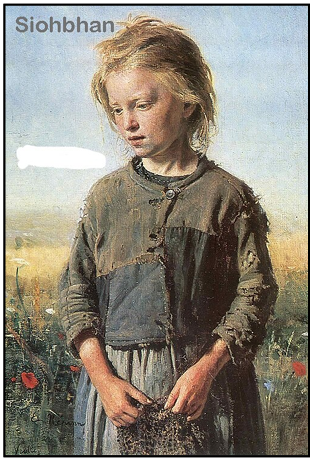
Listen to “Siobhan’s Baby” (Audio Story)
Bang! Siobhan woke with a start. The house was dark, save for a sliver of moonlight illuminating a portion of the cottage. She looked over toward the door, which was swinging back and forth with the wind. The sharp slam must have been what woke her. It was only three o’clock in the morning—far too early for her mother to begin the household chores.
Confused and still groggy with sleep, she stood up awkwardly and walked toward the door to close it.
Then she saw a faint figure a short distance away, carrying a bundle in her arms. Her baby! It had to be her baby wrapped in that bundle! She was quite sure the woman carrying it was the same person who had helped deliver her child just a few hours ago. At fourteen years old, her hips were not yet fully developed to allow for an easy delivery. After a long and difficult birth, she had slowly drifted off to sleep, entirely unaware of what happened next.
Where was the woman taking her baby? Why did her mother give her child away? These questions raced through Siobhan’s mind as she furtively followed the woman into the dark. Guided only by the crescent moon, she soon caught the scent of the sea. Ignoring the slight trickle of blood running down her thighs, Siobhan darted from shadow to shadow, making sure she remained unsee
Kildonnan and the Island
Siobhan worked on Kildonnan Farm on the Isle of Eigg, a small island in the west of Scotland where many of her wider family members were also employed. Kildonnan was named after the Irish saint Kildonnan, who was martyred alongside his monks in 617 AD by the Pictish queen, the “Queen of Moidart,” who resented Donnan and his monks “squatting” on her land, trying to influence the islanders’ beliefs, and challenging her rule. It remains uncertain whether Donnan’s remains rest in the grounds of Kildonnan Church, though many believe they do. Over the centuries, however, members of Siobhan’s own family had all been buried in the church grounds.
The older children in Siobhan’s family were also employed on other farms across the island to help bring more food to the table. When Siobhan was younger, her tasks typically involved gathering shellfish and seaweed on the beach or picking berries and fruit in the hills, meadows, and woods. She always favoured the latter, as the island boys frequently teased the girls who came to gather shellfish and seaweed on the beaches, especially Laig farm beach and the nearby Singing Sands.
Singing Sands Beach
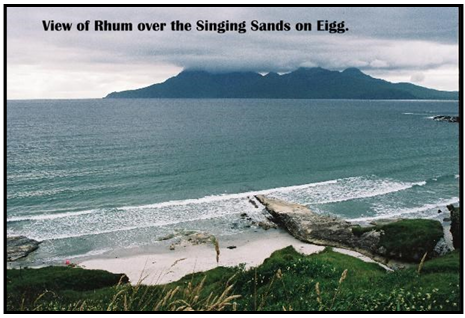
The Singing Sands earned their name because the quartz-rich sand can make a surprisingly musical squeaking or chirping sound when you walk or scuff your feet through it; in Gaelic, the beach is called “Camas Sgiotaig”. The Scottish geologist and writer Hugh Miller visited Eigg in the 1840s and described deliberately kicking the dry sand to draw a “shrill sonorous note” from it.
It was an unspoken rule that the boys were the “kings” of the beaches, and the girls could only gather shellfish and seaweed when the boys were not around.
A heavy shadow had already fallen over Siobhan when her friend Mary Campbell died after accidentally eating poisonous belladonna berries. Mary was buried in the Kildonnan churchyard family plot, not far from the rumoured grave of Kildonnan and his monks. Siobhan almost died too, but was lucky enough to survive. Some time after her near-death experience, her mother announced she had to go and work on the Kildonnan farm managed by one of the Campbells.
It proved a fateful choice. Siobhan was a radiant flower, a delight to behold, and deeply susceptible to the compliments of the farm’s shepherds and ploughmen. She was like “forbidden fruit” ripe for the picking. The farms were places of labor, but also places of desire, and on a small island like Eigg, everyone knew everyone else.
The boys and men desired to possess her. Many young girls of Siobhan’s age would often disappear for months, only to return mysteriously to work again. Siobhan never knew where they went during those absences; all she noticed was that the girls had grown “fat” before they stopped working.
The barns, fields, and woods provided ample “marriage beds” for the young farm workers.
One day, a farmhand named Hector MacKinnon called Siobhan over to the barn to watch a cow give birth. Excited by the prospect, she followed him to the farthest end of the structure. There on the ground lay a pregnant cow—though it showed no immediate signs of labor and simply lay sleeping.
“A will show ye hou a cow like yu gets pregnant,” he said.
With that, he grabbed her and laid her down on the straw. “It will be our own little secret. Ye canae tell anyone else.”
Siobhan didn’t understand what was happening as he pulled down her undergarments and touched her where blood effused every month. She felt uncomfortable, but he promised to give her biscuits and sweets the next time they met if she allowed him to continue. Desperate for a rare treat, Siobhan readily agreed, having been hungry all her life due to the island’s scarce food supply. She had no idea whether what he was doing was right or wrong.
Later, Hector rewarded her with biscuits, sweets, vegetables, and eggs from the garden and hens he tended. Siobhan and her mother were only too happy to receive such sorely needed gifts. Though the Kildonnan Farm garden was famous for winning prizes, most of its produce normally ended up on the table of the island’s English Lord. Siobhan soon welcomed further visits to the barn, beginning to start enjoying the warmth and sensations of Hector’s strong, vibrant boyish body.
Hector Moves Away
One day, Hector grew distant upon noticing her stomach expanding. Frightened by changes he refused to explain, he quit his job and found work on a small neighboring island, the Isle of Muck.
Siobhan’s mother was alarmed to notice her daughter’s changing appearance and quickly realized she was pregnant. She formed a plan common among mothers of the island for their young, unwed daughters: she consulted Roisin, whom everyone knew could “take care” of unwanted babies.
When Siobhan reached her ninth month, Roisin arrived at their house to help deliver the child.
Siobhan Following Roisin to the Beach
Returning to that fateful night, Siobhan snapped out of her reverie as Roisin reached the seashore—none other than the Singing Sands beach.
Hiding behind a clump of bushes, Siobhan watched Roisin place the baby on the sand, dig a shallow hole, and bury the infant inside before walking away. Appalled by what she had witnessed, Siobhan waited until Roisin was far off, then crept to the makeshift grave and dug frantically with her bare hands. She lifted her baby into her arms, but it was already dead.
With tears streaming down her cheeks, she gently rocked her child, whispering over and over, “I’m sorry. I’m sorry.” As dawn broke over the horizon, she kissed the infant’s forehead one last time. “Fly free, ma little angel. Let the shore no be yer grave. Let the sea embrace ye wi its lovin arms.”
With those words, Siobhan gently threw her baby into the waves. She watched it sink slowly to the bottom until the sun’s first rays touched the shore and the baby was gone.
Postscript: Historical Realities of Victorian Infanticide and Baby Farming
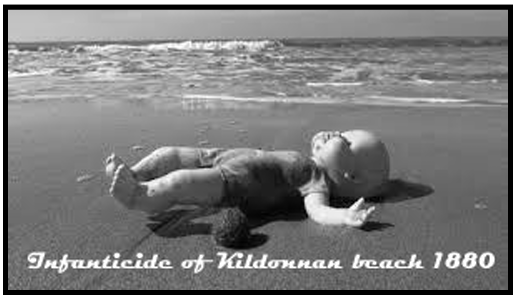
Baby farming was the Victorian practice of taking in babies—usually illegitimate infants—for payment, often by women advertising as foster mothers. Tragically, some babies were neglected or deliberately killed so the “farmer” could keep the money.
The sands of Eigg’s beaches “sang” when children played among the coves, singing in joyful response, but shuddered when they became the receptacles of dead infants, fearing they would never be able to sing again. Historical research into Scotland’s People vital records reveals probable infant murders on the Isle of Eigg in the late nineteenth century, many of which went entirely uninvestigated by authorities.
While tragic accidental child deaths—such as the story of Hugh Campbell falling from cliffs at age six while hunting Shearwater chicks—were sometimes looked into, suspicious infant deaths were largely ignored. Illegitimacy brought social destitution, and without adequate legal protections or financial support before the Bastardy Laws reform of 1872, desperate mothers often turned to secret solutions or local carers.
As historical literature and academic studies (such as Dorothy L. Haller’s research on Victorian baby farming and Elizabeth Ritchie’s work on island infanticide) demonstrate, the rigid religious and social ideals of Victorian Britain created an unforgiving environment for poor, unmarried women. Archival discoveries of unnamed infants washed ashore remain a haunting testament to a hidden crisis in nineteenth-century Britain.